Saturday, 20 November 2021

Wild Service Tree seeds


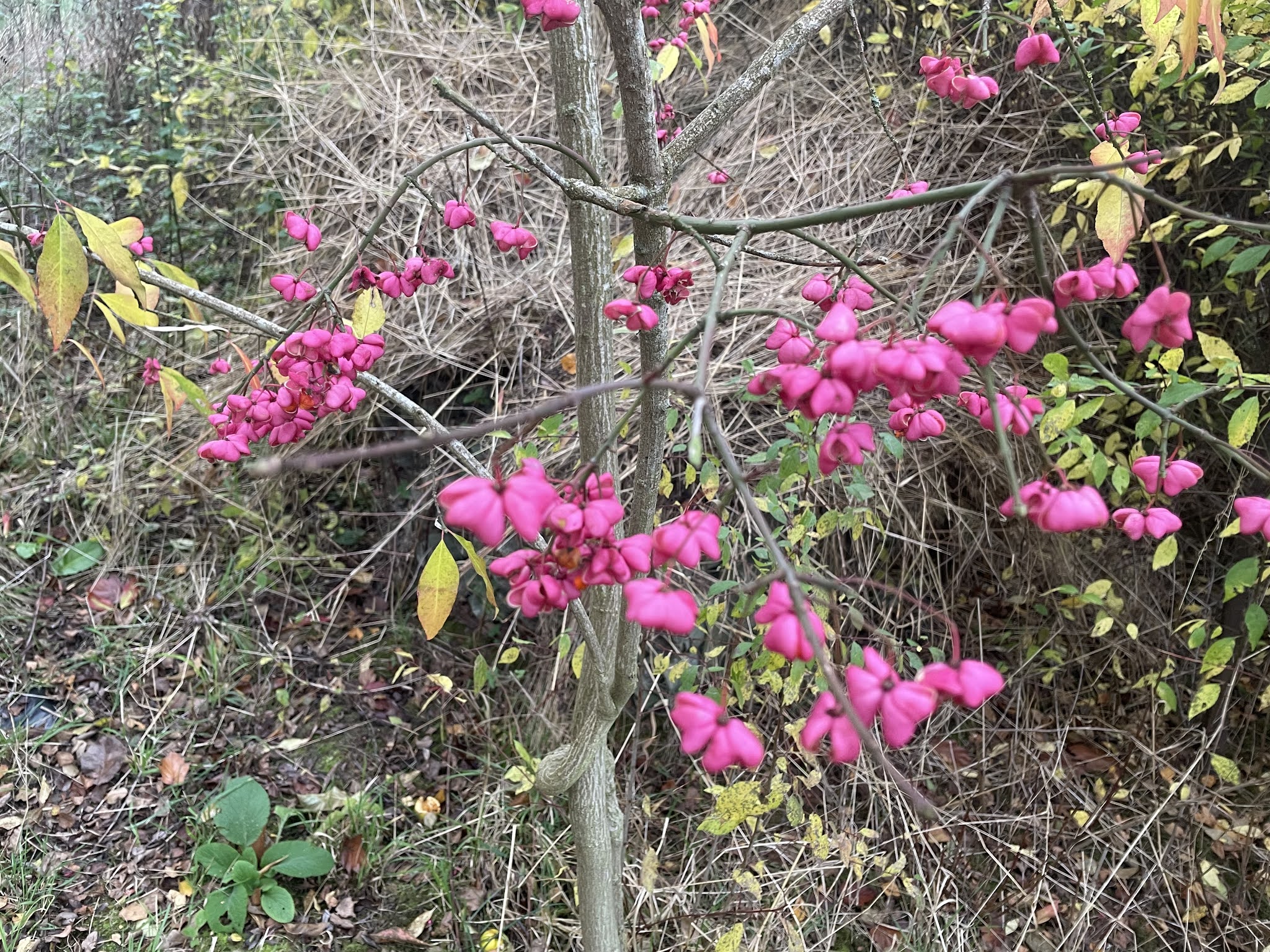
The pink of the wild service trees along the woodland edges is bright in autumn sunshine. In the recently coppiced areas the additional light has given a noticeable boost to growth and fruiting even in the first year..


The bright orange seeds are dropping out as the pink fruit open, so the seeds must now be ripe.


In previous years I have planted these seeds at this time of year (autumn), but they have not grown - I guess either rotted over winter, or one year apparently dug up and eaten by mice.

So this year I am storing the seeds until spring and will try planting them then to see if this is a bette way of growing a few more of these interesting trees.


Sunday, 14 November 2021

More Bug Hotels

 Last years green tree tubes are being put to good use to make ‘bug hotels’. I have cut the tubes into two, and pushed four of the resulting tubes inside each other.


At the back of the tubes I have built a solid board to prevent a cold wind blowing through.


There is the a wrap of recycled chicken wire around the tubes.


This gives the final ‘hotel’ with the old tree posts forming a roof. 


Sunday, 17 October 2021

Comfrey cuttings

 I have several comfrey plants which seem to do very well in damp semi shaded areas of rough grass and nettles. The flowers attract bees (when the neighbourhood farmers haven’t killed them all with spray - our colony of mason bees have all disappeared the day after a neighbouring field was sprayed. Same thing has happened two years in a row).  I love the way that comfrey competes with the grass and nettles by putting on an early autumn spurt of new leaf growth which then dies with the first frost and flops to the ground smothering the surrounding competition. The dead leaves are robust and form a ‘mulch mat’ around the plant in the spring.

However the few comfrey plants are not increasing in number so I am using the autumn growth spurt to take cuttings. To create genetic diversity I take cuttings from different plants.

A growing tip with the lower leaves cut off seems ideal.

These go in a jam jar on a sunny windowsill for 4 to 6 weeks.


They are ready to plant out when new roots have started to form. Don’t worry if the  leaves are looking grey or spotted with mold - as long as there are roots they will do OK.

As the roots are use to being submerged in water keep them that way by putting the pots into a container of standing water.

Once the roots show at the bottom of the pot the plant can be planted into a larger pot to overwinter.


You will soon see a little new growth. I have done this once before and put the pots in the greenhouse over the winter as I thought that the cuttings would not be very robust, having only just rooted. However I am not sure if this is necessary.


So as an experiment this year I have taken 8 cuttings so I will leave half outside and half in the greenhouse over the winter to see if it is necessary to keep them sheltered.

Friday, 24 September 2021

More grass cutting and planting

It’s certainly time for the summer flowering areas around the wildflower meadow to be cut short so that the seeds have the light and air to germinate. This is being done later than ideal - it would be better to have more time for seedlings to develop before the colder weather starts. Ideally the end of August would have been better than the end of September.


For a good article on the difference between spring meadow and summer meadow cutting regimes see https://sussexwildlifetrust.org.uk/discover/in-your-garden/article/124

The main meadow and woodland glade are being developed as a spring meadow - so they grow through the spring and early summer, are cut for hay in late July and the are continually cut short through the late summer and autumn. This give a good opportunity for early spring flowers.

The hedgerow bottoms shown here are cut on a summer meadow cycle - being cut in late September and then kept short in the first couple of months in the spring. Not cut from May onwards, then cut again late September.

The trusty front bar cutting mower (Allen Scythe) is ideal for cutting this long, coarse grass.

Cuttings are raked up an taken off into a grass heap to rot or used as a ‘roof’ on the branch piles in the wood to create a sheltered environment for over-wintering insects.


Saturday, 11 September 2021

Summer visitors depart

Have not seen the swallows for a few days now so I think that they have migrated south. They lined up on the wires last weekend. I think this is two pairs, each with two young.


This year we have only had two nests and maybe four young fledged. This is a big change from 15 years ago when we had 5 or 6 nests each with sometimes two broods in a year. It may just be local variation, but I worry that the declining insect numbers are to blame. The Insect Armageddon is plain to see every time I look at the clean car windscreen after a summer drive. It did not used to be this way, widespread use of pesticides in farming is the most likely cause. Our wildflower meadow is just not large enough to mitigate the effects of the surrounding industrial farmlands. For the last two springs our masonry bee hives have died off overnight the day the surrounding field was sprayed, probably as the bees range over a larger area than just the wildflower meadow.

It is amazing to think that these swallows will be in Southern Africa in 4 weeks time. Not a bad place to spend the winter!

Monday, 6 September 2021

Meadow cutting


Keeping the grass short after the July hay cut is important to let light and air down to the wildflower seeds. Having failed to harrow the meadow this year I am not sure that the seeds dropped during haymaking have made the best contact with the earth, so long grass is definitely worth avoiding.

The grass had got to about 8 to 10 cm, so using the highest setting on a ride-on mower brought it down to about 4cm.

I tried to cut around the meadow cranesbill which is growing strongly, am not sure if this is right, but I worry that repeated cutting when it is using up so much energy will weaken the plants for the winter. However leaving uncut areas around the cranesbill gives a very ‘patchy’ look to the meadow.

I like this, as it gives variety of habitat rather than on uniform environment. One of my main objectives on a small piece of land is to maximise diversity of habitat, even if it leaves the field looking a bit odd.

We have maybe grown so accustom to the uniform farmed fields of monocrops that are so sterile for wildlife that seeing a ‘patchy’ field looks odd.

I may have to do another cut in about 3 or 4 weeks time. I wish that there was some way of picking up the cuttings to take more nutrients out of the ground, but the mower becomes full quickly that this is just not practical.

Tuesday, 31 August 2021

Let there be light

 I am trying to increase the plant interest of the hedgerow between the wildflower meadow and the woodland. To allow light in to the seedlings at the bottom of the hedge I am cutting the long grass that is blocking the light from reaching the developing plants. 

The front bar cutting mower allows a cut close to the hedge:


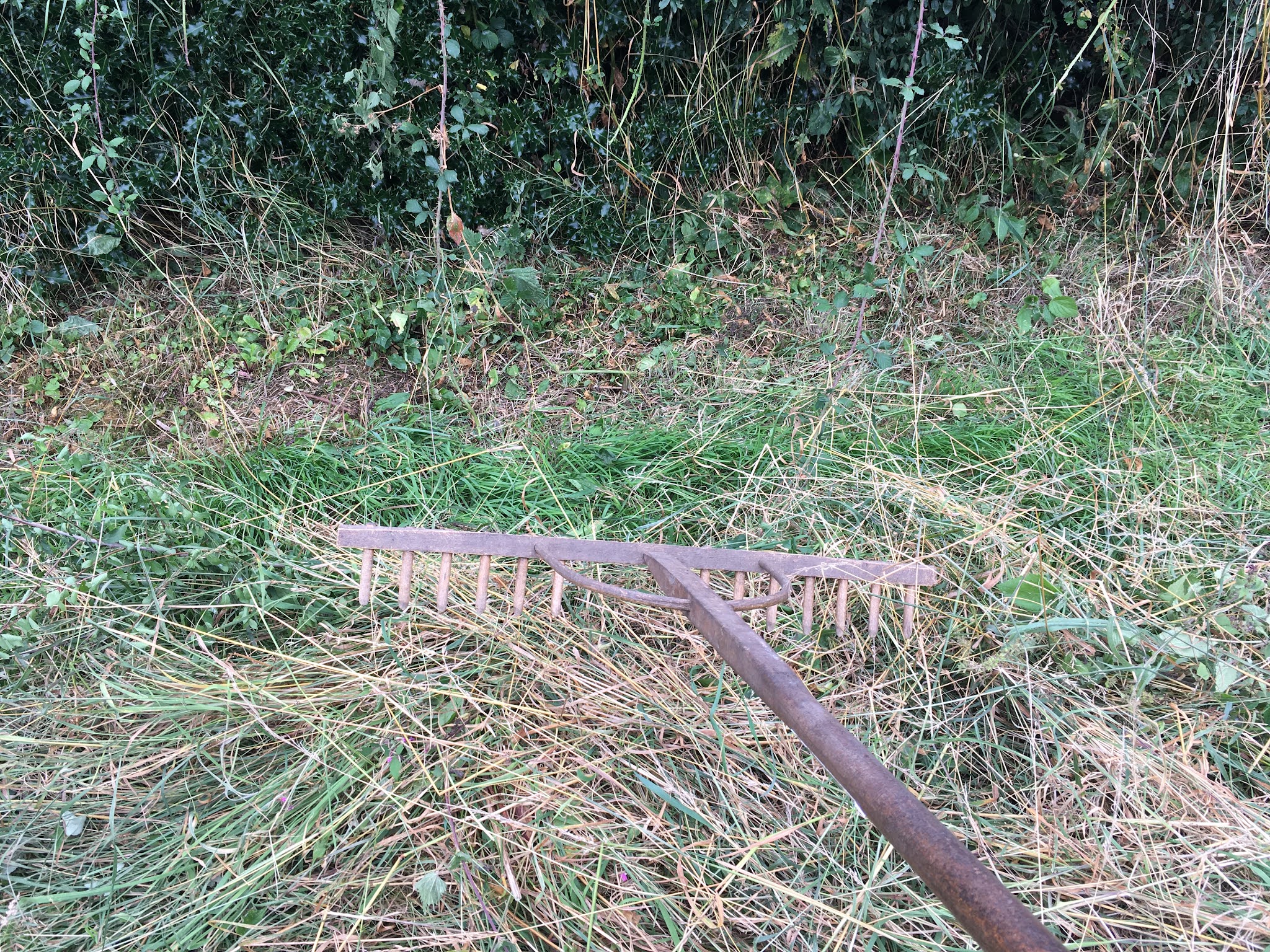
Once cut the grass needs to be dragged out from the hedge. The hay rake is ideal for t hi s:


Once dragged out the grass is rolled up using the rake, and then the pitchfork is ideal for picking up the roll to lug to the grass heap:

The end result is that the plants at the bottom of the hedge, such as Red campion, self heal and garlic mustard, get a chance to grow.