Monday, 27 March 2023

Using old tree protectors

I have written before about using old tree protectors as bug hotels. I am not sure if this is a totally good way to reuse them as eventually they will break down into microplastics throughout the woodland. However while I am pondering what to do longer term it seems like a good idea to put them to use.

This year's development of the bug hotel design is to fill the cavity of the inner tube with twigs to give it that sheltered homely feeling:


The overall design remains the same: tubes cut in half with 4 placed one inside the other to give plenty of crevices to crawl into. Reused tree stakes hammered in to give the support and reused chicken wire to wrap the whole thing to make it stable:


It is important to put a windproof backing so that is snug and warm:


I will pile brush and leaves on top throughout the year to make it a good hibernation place next year.

There is a recycling scheme for green tubes run by Tubeex which looks good, but they only recycle their own tubes and there is a minimum of 6 'bunny bags' for collection at £39 per bag - so it is designed for a large scale than my woodland. Maybe I need to find a nearby commercial planting who also want to recycle.

Wednesday, 8 February 2023

Repairing the dam


 A small dam keeps the water level up in the pond for about 8 months of the year. It is only fed by water runoff from local fields, so dries up to mud in mid-summer. So there are no fish, but lots of insects and amphibians. The runoff is from a cattle farm, so there is a lot of nutrients in the water, making the pond pretty eutrophic - but it is a nice boggy area.

However heavy water flow during the winter has undermined one side of the dam so that water is coming under one side of the dam rather than over the top of the sluice.


To fix this needs a repair on the upstream side of the dam. Any downstream repair will just get eroded.

So the first phase was to hammer in a series of stakes, using recycled tree stakes from the wood. These were put in forming a semi-circle between the central part of the dam and the bank.

I then needed to pack the area above the dam with clay. Luckily the woodland and meadow is on the clay and gravel left by an ice age lake. So dig down almost anywhere and you find clay. In this wheelbarrow the yellowish earth on the right has a high proportion of clay.

This clay was packed into the space between the new stakes and the dam, if effect enlarging the bank above the dam to block any water movement from above.


Hopefully this will fix the problem, but I am going to keep a close eye on any erosion of water along the face of the dam.


Tuesday, 24 January 2023

Winching a tree

Thinning out the woodland is difficult as some of the large trees (such as the pollard willows) do not have enough space to fall and so get ‘hung up’ in neighbouring trees. These are called ‘widow makers’ by lumberjacks as they are inherently unstable and liable to fall uncontrolled if you try and cut them up while still hung up. I cut a reverse notch with the chain saw (sloping side pointing down) so that the cut trunk falls down off the stump even if the top branches get hung up.

The solution is to pull the base of the trunk away from the lean so that the top then falls to the ground, where it can be safely cut up, the firewood taken out and the brash stacked. However the trunks are way too heavy to move by hand.

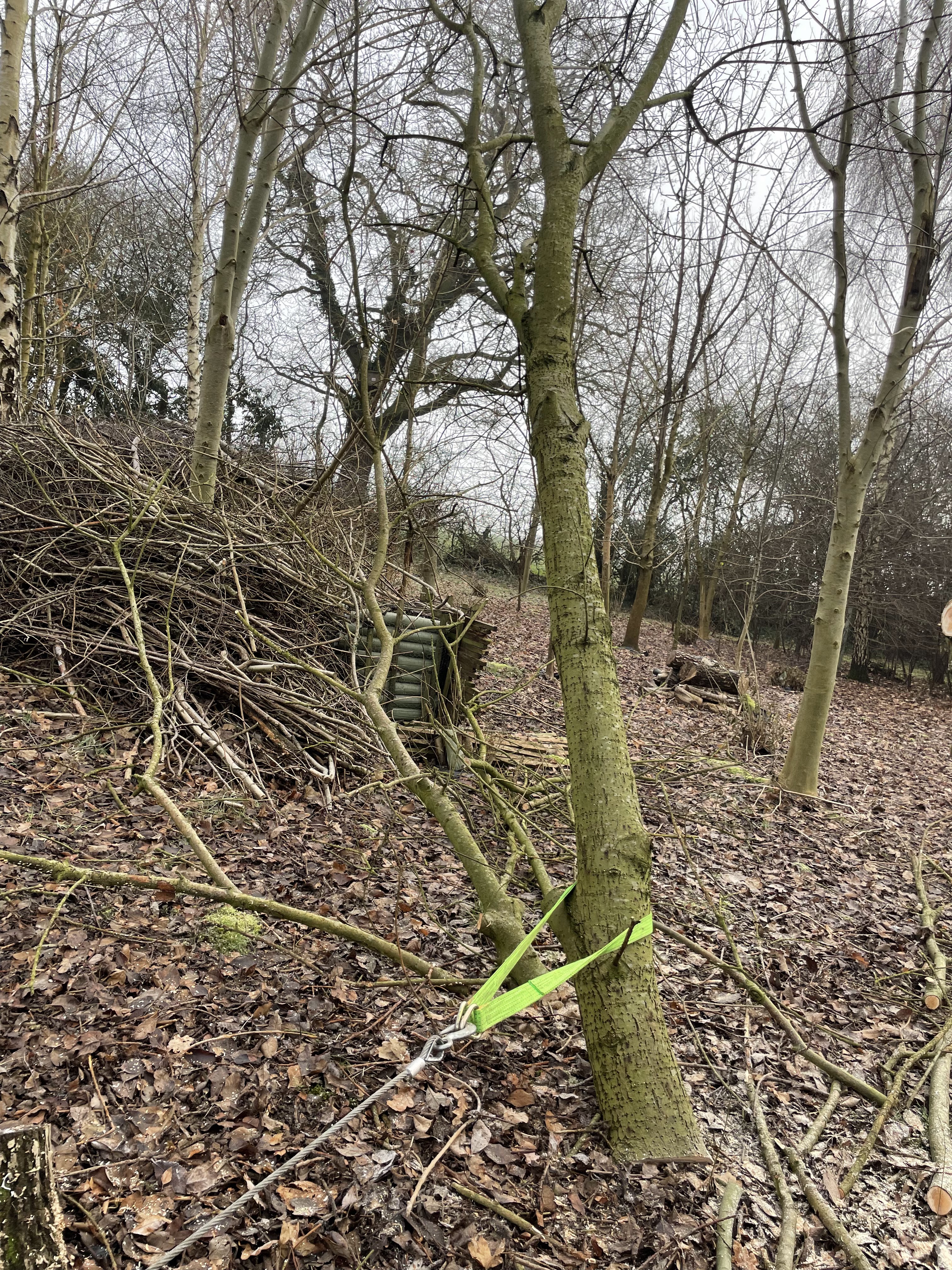
The solution is to us a hand winch, which is secured to a tree.


A block  (pulley) is strapped to another tree which is chosen to give the steel cable a clear run between the coppice stools and to pull the trunk in the correct direction.


A strap is wrapped around the bottom of the cut trunk of the leaning tree.


Using the winch then enables the trunk to be easily pulled away from the direction of lean, which then eases the whole tree  to the ground very slowly and controlled (note the drag mark from the bottom of the trunk). The winch operator is a whole cable length away from the tree and absolutely safe.


Once the tree is on the ground it can easily and safely be cut up.

The winch is a great piece of kit for about £200.


Tuesday, 17 January 2023

Planting out Cowslips in January

For any gardener January is certainly not a time to be planting out seedlings. However the early spring wild flowers are just about to have their early year growth spurt, so now is the time to get the, into larger pots so they can establish.


The cowslips that I planted in seed trays last year are not in great condition. They have been sitting on a concrete surface and have been waterlogged by the recent weeks of rain, with some leaves going yellow. However there are also small new green leaves so I think that they will be fine. The plants have a dense mat of moss on the surface which will need to be removed so that there is no competition with the cowslips.

Some of the seedlings have been planted out into pots - a technique pretty much guaranteed to give a good plant to put out into the meadow in the autumn.

However, I am also trying something new. Last year I had success by planting out a seed tray that had many small foxgloves. This was just a tray that I did not have time to put into individual pots, so I just stuck it in the ground and surprisingly it formed a nice patch of flowers. So I wondered if the same thing would happen with cowslips. These trays have several small plants which I hope will grow together a form a nice clump which will be able to stand up to competition from the grass once planted out in the meadow.

There is a slight concern that the roots of the cowslips will grow sideways rather than down, and so when planted out will not be able to get below the grass roots in the competition for water and nutrient. However as they will be planted out into a shallow tray sized hole (using a spade to cut out an area of grass the same size as the tray) I am hoping that the grass roots will be far enough away for the cowslips to re-orientate and grow downwards. Time will tell - update coming later in the year.

Monday, 26 December 2022

In praise of messy coppicing

I was recently told that my coppicing looked “messy”. I took this as a compliment as it referred to the piles of branches and log heaps that I am making, which provide sheltered habitat for insects, amphibians, birds, hedgehogs and mice as well as enriching the fungal content of the ground.

These heaps may look messy, but they are an integral part of the management plan for the woodland. An important consideration is the safety of the person who will be doing the next round of coppicing in 7 years time (hopefully me!). Log piles are potential trip hazards so they are always located downhill from a brush heap (the brush heaps will still be easy to see).

The brush heaps flatten down pretty quickly over a year or two as the branches decay and settle. A heap 12 feet high now will be only 6 feet high next year and then settle to about 4 feet where it will stay. This means that on the next Coppice cycle the same set of heaps can be added to - which will ensure that I don’t cover over any nice wildflowers.

Monday, 26 September 2022

Hibernation zones

Some areas around the meadow and strips of hedge bottom are left for the later flowering summer flowers (the main wildflower meadow is a spring meadow so cut in late July). The flowers (such as ox-eye daisy, common agrimony, hemp agrimony, borage, mallow and feverfew) have set seed, so these areas have been cut with the trusty Allen Scythe.

The cuttings have been pitchforked on top of 2 year old wood piles in the Coppice. I am hoping that this will give a layered environment with damp rotten wood at the bottom, then a dry lattice of dead branches, finally topped off with the protective ‘roof’ of straw like cuttings:


This looks like it will create a great hibernation place - sheltered with a variety of environments.

Monday, 19 September 2022

Long post to catch up

Long time since the last post - so a number of things to catch up on:

First is the results of the experiment in overwintering the borage plants wither in the green house ot outside. The results are clear: Kept in the greenhouse - 100% dead. Kept outside - 80% alive. Lots of planting out has been done of seeds that have germinated after being in trays all winter - again it seems that the trays that were kept outside and brought into the greenhouse at the end of February did best. I wonder if the moisture content is key. The higher humidity in the green house over the winter may lead to seeds rotting (there seemed to be mould on the surface of some of the trays kept in the greenhouse).

The jury is still out on the experiment of planting snake's head fritillaries in individual trays. They germinated very well (both those in the greenhouse and those kept outside), producing single grass-like leaves. However these disappeared in the early summer, at about the same time that the mature plants in the field also loose their leaves. I am not sure if the plants in the trays died, or if they have formed bulbs which will come up again next year. I have kept the trays moist over the summer and will keep them well drained outside over the winter - so it will be interesting to see if they come up again in the spring.


The wildflower meadow was superb in the spring, however after it was cut it has remained yellow throughout the summer as the drought stopped any germination or growth. interesting to see how this will affect next spring. The hay rattle was abundant so we collected lots of seed and spread it around the field, especially in some of the areas where the grass is still quite vigorous.


The trees in the woodland have suffered through the drought, with a lot of premature leaf fall, especially from the rowan and silver birch. The rowan had lost nearly all of their leaves by the end of September, but produced a large crop of berries - which might itself be a sign that the tree is under stress.