Tuesday, 5 March 2024

We have several muntjac deer around, who seem to love the tops of bluebells and wood anemone. So this year I have used some of the brash from winter coppicing to for an enclosure. Its probably not completely deer-proof, but it might just prevent casual grazing of the bluebells 'in the green' that we have planted inside.


Wednesday, 19 July 2023

Owlets calling for food

There are two tawny owlets calling in the wood. They start up each night about half an hour before sunset with a ‘feed me’ call which continues for an hour or so until one of the adults swoops across from a neighbouring area of mature woodland, then all goes silent. The owlets call from deep within branches and I don’t want to disturb them too much so I have not had a good view- just a flash of light brown wings.

It is amazing to think that at the beginning of this project there was just a horse grazed field, and now there is a diverse environment which can support owlets!

Monday, 27 March 2023

Using old tree protectors

I have written before about using old tree protectors as bug hotels. I am not sure if this is a totally good way to reuse them as eventually they will break down into microplastics throughout the woodland. However while I am pondering what to do longer term it seems like a good idea to put them to use.

This year's development of the bug hotel design is to fill the cavity of the inner tube with twigs to give it that sheltered homely feeling:


The overall design remains the same: tubes cut in half with 4 placed one inside the other to give plenty of crevices to crawl into. Reused tree stakes hammered in to give the support and reused chicken wire to wrap the whole thing to make it stable:


It is important to put a windproof backing so that is snug and warm:


I will pile brush and leaves on top throughout the year to make it a good hibernation place next year.

There is a recycling scheme for green tubes run by Tubeex which looks good, but they only recycle their own tubes and there is a minimum of 6 'bunny bags' for collection at £39 per bag - so it is designed for a large scale than my woodland. Maybe I need to find a nearby commercial planting who also want to recycle.

Wednesday, 8 February 2023

Repairing the dam


 A small dam keeps the water level up in the pond for about 8 months of the year. It is only fed by water runoff from local fields, so dries up to mud in mid-summer. So there are no fish, but lots of insects and amphibians. The runoff is from a cattle farm, so there is a lot of nutrients in the water, making the pond pretty eutrophic - but it is a nice boggy area.

However heavy water flow during the winter has undermined one side of the dam so that water is coming under one side of the dam rather than over the top of the sluice.


To fix this needs a repair on the upstream side of the dam. Any downstream repair will just get eroded.

So the first phase was to hammer in a series of stakes, using recycled tree stakes from the wood. These were put in forming a semi-circle between the central part of the dam and the bank.

I then needed to pack the area above the dam with clay. Luckily the woodland and meadow is on the clay and gravel left by an ice age lake. So dig down almost anywhere and you find clay. In this wheelbarrow the yellowish earth on the right has a high proportion of clay.

This clay was packed into the space between the new stakes and the dam, if effect enlarging the bank above the dam to block any water movement from above.


Hopefully this will fix the problem, but I am going to keep a close eye on any erosion of water along the face of the dam.


Tuesday, 24 January 2023

Winching a tree

Thinning out the woodland is difficult as some of the large trees (such as the pollard willows) do not have enough space to fall and so get ‘hung up’ in neighbouring trees. These are called ‘widow makers’ by lumberjacks as they are inherently unstable and liable to fall uncontrolled if you try and cut them up while still hung up. I cut a reverse notch with the chain saw (sloping side pointing down) so that the cut trunk falls down off the stump even if the top branches get hung up.

The solution is to pull the base of the trunk away from the lean so that the top then falls to the ground, where it can be safely cut up, the firewood taken out and the brash stacked. However the trunks are way too heavy to move by hand.

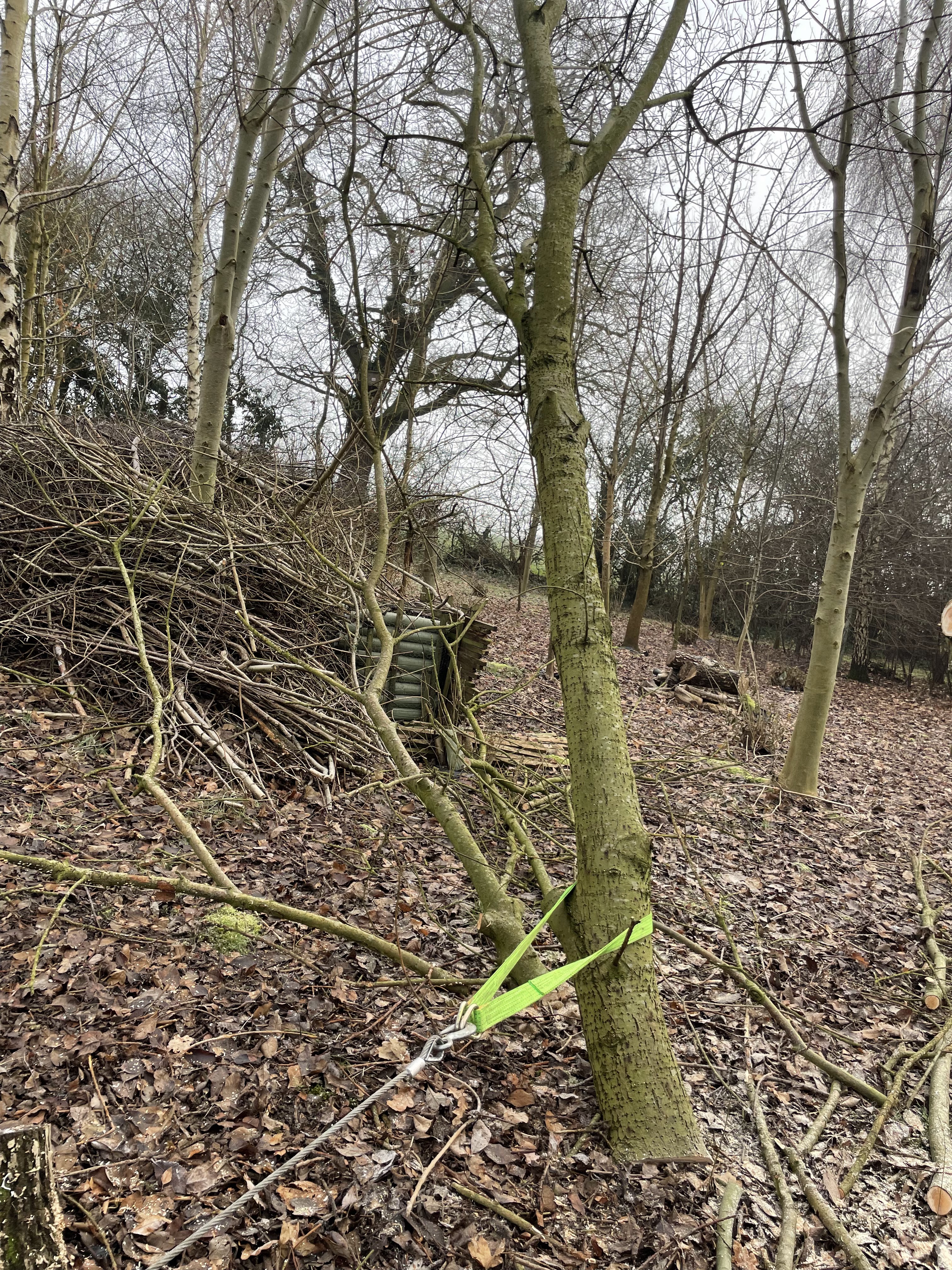
The solution is to us a hand winch, which is secured to a tree.


A block  (pulley) is strapped to another tree which is chosen to give the steel cable a clear run between the coppice stools and to pull the trunk in the correct direction.


A strap is wrapped around the bottom of the cut trunk of the leaning tree.


Using the winch then enables the trunk to be easily pulled away from the direction of lean, which then eases the whole tree  to the ground very slowly and controlled (note the drag mark from the bottom of the trunk). The winch operator is a whole cable length away from the tree and absolutely safe.


Once the tree is on the ground it can easily and safely be cut up.

The winch is a great piece of kit for about £200.


Tuesday, 17 January 2023

Planting out Cowslips in January

For any gardener January is certainly not a time to be planting out seedlings. However the early spring wild flowers are just about to have their early year growth spurt, so now is the time to get the, into larger pots so they can establish.


The cowslips that I planted in seed trays last year are not in great condition. They have been sitting on a concrete surface and have been waterlogged by the recent weeks of rain, with some leaves going yellow. However there are also small new green leaves so I think that they will be fine. The plants have a dense mat of moss on the surface which will need to be removed so that there is no competition with the cowslips.

Some of the seedlings have been planted out into pots - a technique pretty much guaranteed to give a good plant to put out into the meadow in the autumn.

However, I am also trying something new. Last year I had success by planting out a seed tray that had many small foxgloves. This was just a tray that I did not have time to put into individual pots, so I just stuck it in the ground and surprisingly it formed a nice patch of flowers. So I wondered if the same thing would happen with cowslips. These trays have several small plants which I hope will grow together a form a nice clump which will be able to stand up to competition from the grass once planted out in the meadow.

There is a slight concern that the roots of the cowslips will grow sideways rather than down, and so when planted out will not be able to get below the grass roots in the competition for water and nutrient. However as they will be planted out into a shallow tray sized hole (using a spade to cut out an area of grass the same size as the tray) I am hoping that the grass roots will be far enough away for the cowslips to re-orientate and grow downwards. Time will tell - update coming later in the year.

Monday, 26 December 2022

In praise of messy coppicing

I was recently told that my coppicing looked “messy”. I took this as a compliment as it referred to the piles of branches and log heaps that I am making, which provide sheltered habitat for insects, amphibians, birds, hedgehogs and mice as well as enriching the fungal content of the ground.

These heaps may look messy, but they are an integral part of the management plan for the woodland. An important consideration is the safety of the person who will be doing the next round of coppicing in 7 years time (hopefully me!). Log piles are potential trip hazards so they are always located downhill from a brush heap (the brush heaps will still be easy to see).

The brush heaps flatten down pretty quickly over a year or two as the branches decay and settle. A heap 12 feet high now will be only 6 feet high next year and then settle to about 4 feet where it will stay. This means that on the next Coppice cycle the same set of heaps can be added to - which will ensure that I don’t cover over any nice wildflowers.

Monday, 26 September 2022

Hibernation zones

Some areas around the meadow and strips of hedge bottom are left for the later flowering summer flowers (the main wildflower meadow is a spring meadow so cut in late July). The flowers (such as ox-eye daisy, common agrimony, hemp agrimony, borage, mallow and feverfew) have set seed, so these areas have been cut with the trusty Allen Scythe.

The cuttings have been pitchforked on top of 2 year old wood piles in the Coppice. I am hoping that this will give a layered environment with damp rotten wood at the bottom, then a dry lattice of dead branches, finally topped off with the protective ‘roof’ of straw like cuttings:


This looks like it will create a great hibernation place - sheltered with a variety of environments.

Monday, 19 September 2022

Long post to catch up

Long time since the last post - so a number of things to catch up on:

First is the results of the experiment in overwintering the borage plants wither in the green house ot outside. The results are clear: Kept in the greenhouse - 100% dead. Kept outside - 80% alive. Lots of planting out has been done of seeds that have germinated after being in trays all winter - again it seems that the trays that were kept outside and brought into the greenhouse at the end of February did best. I wonder if the moisture content is key. The higher humidity in the green house over the winter may lead to seeds rotting (there seemed to be mould on the surface of some of the trays kept in the greenhouse).

The jury is still out on the experiment of planting snake's head fritillaries in individual trays. They germinated very well (both those in the greenhouse and those kept outside), producing single grass-like leaves. However these disappeared in the early summer, at about the same time that the mature plants in the field also loose their leaves. I am not sure if the plants in the trays died, or if they have formed bulbs which will come up again next year. I have kept the trays moist over the summer and will keep them well drained outside over the winter - so it will be interesting to see if they come up again in the spring.


The wildflower meadow was superb in the spring, however after it was cut it has remained yellow throughout the summer as the drought stopped any germination or growth. interesting to see how this will affect next spring. The hay rattle was abundant so we collected lots of seed and spread it around the field, especially in some of the areas where the grass is still quite vigorous.


The trees in the woodland have suffered through the drought, with a lot of premature leaf fall, especially from the rowan and silver birch. The rowan had lost nearly all of their leaves by the end of September, but produced a large crop of berries - which might itself be a sign that the tree is under stress.


Sunday, 20 March 2022

End of coppicing and spring in full swing


The Last of the clear up after coppicing is finished! Leaving piles of logs and brush scattered around is a great way of supporting fungal growth in the soil and providing habitat. The fashion for tidiness in woodland and burning any cuttings is not good for wildlife.

The last tree to be cut was one of the willows. As a pollard this will provide a much more interesting habitat than a straight up and down tree.
The bumble bees have been out and about for three weeks now. I wondered what they were feeding on as there are so few flowers out. I then saw the bees high in willow trees where these flowers must be providing the sustainable that the bees needed in the first few days of March.

Some additional construction of bug hotels has finished off the work in the woods. 


Sunday, 20 February 2022

Oliver Rackham and a day of pollarding

 It’s such a rainy day I been reading Oliver Rackham’s book about landscape history. Interesting to speculate about what he would think about my woodland creation. Probably he would have been fairly negative about the biodiversity - and said that I would be much better spending my time in the restoration of a coppicing cycle in an ancient woodland rather than trying to create a new woodland. This was illustrated by the story of the woodland planted by monks 750 years ago which still doesn’t have as rich a flora as the adjacent ancient woodland.

Fascinating to read about how human activity has altered all of our environment, with echos of history in the patterns of fields, the hedgerows and woodlands.

Pollarding the willows.
Yesterday was Solent pollarding willows in the woodland. The branches are too high to cut with a chain saw, as using a chain saw at head height seems unwise. A hand chain saw is the answer, as the ropes either side of the chain allow us to be 10m from the tree being cut. However, it is a really good upper body workout!
Pollarding creates lots of branches, as well as rotten wood good for insects and holes for nesting.


Saturday, 12 February 2022

Expertise from Woodland Trust

 I have come across this recently published manual from the Woodland Trust - the "Woodland Creation Guide".


It is pretty detailed (more than 300 pages) and is definitely not 'light reading'. It made me start reflecting on what I would do differently if starting again today:

1) I would pay more attention to the edges of the woodland and not plant 'future big' trees (such as oak and beech) near the woodland edges. I am correcting this now by selective thinning - leaving the smaller trees (such as service, wayfaring, hawthorn) around the edges, but I could have saved myself some work by panning this from the beginning.

2) I would not use plastic tree protectors, plastic mulch mats and tannalised stakes. There is no good evidence that these additions make the trees grow better, and they will give long term low level plastic and microplastic pollution. I have tried to mitigate the negative environmental impact by constructing 'bug hotels' (see past posts) out of the tree protectors and stakes.

3) I would have planted less trees - I used 1m centres which is way too close. 3m apart if probably about right.

If you are thinking of planting a woodland this guide is a 'must read'.

Saturday, 5 February 2022

A birding first and early signs of spring

A new bird for the woodland - a goldcrest being busy, busy, busy flittering around the old alder seed heads. This takes the total bid list for the woodland and wildflower meadow to 69.

Coppicing and thinning continues, but there seem to be some early signs of spring:

The catkins have been out for a couple of weeks, but today for the first time I noticed the tiny red female hazel flowers

Underfoot the bluebells are poking their heads into the leaf litter


There are leaves of Herb Robert showing:


The weather has been so mild that we are having a ridiculously early spring - we don't usually have to mind our footsteps while coppicing to avoid the bluebells. 


Saturday, 22 January 2022

About halfway through coppicing


 Current work is all focussed on the coppicing. Removal of the underwood makes a huge difference to the look and feel of the wood. This is what the wood looks like before coppicing:


After coppicing there is much more light getting to the floor. 


Some of the larger trees need to be cut - removing the birch and pollarding the willow. As they are close together the trees don’t fall, so the winch is pretty essential to safely pull the butt of the tree so it can come to the ground to be cut and stacked. In this photo the hadn't winch (in the foreground) has a cable running to the right to a winch pulley (also called a diverter pulley, snatch pulley, snatch block or pulley block) attached to a tree with the green strop. This pulley bends the cable so that the tree can be pulled in the bet direction. The tree that has been pulled is lying on the ground top left, with a mound of earth in front of the butt which has been created as it is pulled along:


I am starting new brush piles in next year’s compartment so that I can plant bulbs in the new compartment this autumn without covering when next winters cutting starts. So these sequence in each of the 7 compartments of the wood is:

1) In winter 1: start the brush heaps using the cuttings from the neighbouring compartment.

2) In autumn: plant bulbs (such as bluebell, wild garlic and wood anemone) avoiding the brush piles

3) In winter 2: coppice the compartment - putting cuttings on the already located brush heaps so you know that you are avoiding your newly planted bulbs.

4) In spring: as bulbs come up for the first time there is lots of light for them in the newly cut compartment. 

I have 3 or 4 brush heaps for each half acre compartment. At the bottom of the heap I have put a pile of the large logs that are unstable for splitting (because they had branches coming off so have 'knots' in the wood). I hope that this will make a very nice habitat for amphibians:


The traditional method of woodland management involves use of the underwood - which had many uses in the past (wattles, posts, charcoal, firewood, stakes, pales, faggots, fodder, bark for tanning and many, many more). Today I only use it for firewood. The smaller wood is cut into 'cord wood' - traditionally 4 foot lengths, which I will cut into 4 pieces on a bench circular saw when coppicing has finished in the spring. The larger pieces have been cut into lengths with the chain saw - each about a foot long. Of course the wood does not from nicely in these dimensions so in practice length is variable around these dimensions:


Monday, 3 January 2022

Heaps of new accommodation

When I was working as a teenager with the Sussex Wildlife Trust conservation corps in the coppiced woodlands of West Dean Woods we used to burn all of the cut trees that could not be used for either firewood or hurdle making. Currently in the woodland I am piling the 'brash' into heaps.


This is a bit more work as all the wood and twigs needs to be heaved on top of the piles, but it has the advantages of providing habitat and having areas of rotting wood which I hope will enrich the developing Mycorrhizal Fungal Network which I hope I am creating under the ground in the woodland.


Mycorrhizal Fungal Networks are the unseen powerhouse of a woodland and take many, many years to develop. They link the trees and plants together and move nutrients and water around - having at some time been called a 'communication system' between the trees in a wood. Just planting trees does not create a woodland - which is why Oliver Rackham was so dismissive of 'compensatory' planing of new woodland for the destruction of ancient woodland. Those new 'compensation' trees will take many hundreds of years to develop into what we loose every day under the shovel of development.


Rapidly developing an underground hyphal network may be a forlorn hope, but the wood heaps do provide a great habitat for birds nesting (especially robins and wrens), amphibians (toads, newts and frogs), and all manner of bugs as a secure over-wintering site.


As the wood rots a large number of different fungi appear and the heap decreases in size by about two thirds over the year. I plan to re-use the same sites within each compartment so that I am not putting the news heaps on top of the wildflowers that I am try ing to establish. As I move down each compartment of tree coppicing I  re-use the heaps in the previous year's compartment, so each heap has wood over 2 years on top of it, then a rotting phase of 5 years in the 7 year coppicing cycle. I think that in the next cycle each heap will just be a pile of rotten wood, which will be a great habitat when a whole new pile of branches is put on top.


Sunday, 26 December 2021

Starting coppicing - late!

Starting coppicing of Compartment 5 today - a bit late in the year to be starting, but delayed by Covid and having to get the ducks and hens into bird flu secure accommodation.

Hazel is being cut at a 45 degree angle with the cuts facing out from the middle of the stool to take water away and prevent rot. About half of the birch are being cut down, as they have done their job as a 'pioneer species' protecting the slower growing trees from the wind. The tops of the blackthorn and hawthorn is being cut off and they are then being cut partway through at the base and pushed over. This will create new shoots at ground level rather than growing high. All of this is to create different layers in the canopy which gives a variety of different habitats. 


The tops of the trees (anything smaller than about 6cm across) is stacked as wood heaps which provide great habitats for amphibians, nesting sites for robins, over-wintering sites for insects and a hibernation place for hedgehogs.


The wood heaps also give extra insulation to the 'bug hotels' which have been made from the plastic tree tubes (see past posts on this).


Coppicing also lets light to the woodland floor to allow a succession  of woodland plants to grow. Unfortunately as this is new woodland there is not a seedbank in the woodland floor for flowers to grow in response to the extra light in the spring, so i will planting some flowers to get this process started. Some are already moving in on their own - but it will take a very long time! This is why planting new woodlands is never a good substitute for preserving old woodlands.


Saturday, 27 November 2021

Last bulb planting

 It’s getting a bit late, but managed to get the last of the bulb planting done.

100 addition snakes head fritillary in the meadow. The bottom part is wet through the spring so should be a good area for them. It is difficult to see but there is a subtle dip running down the slope which is always damper than the rest of the field. This seems like a perfect place for fritillary, so I am putting lots in here.

Wood anemones are a great very early spring flower, which form a carpet in established woodlands. As I coppice each compartment I am putting in some rhizomes hoping that they will start the process of spreading. I put them in after coppicing as I then know where the wood piles are going to be (as I don't want to put in expensive bulbs and then cover them with a mountain of wood!). 

The wood anemone does not seem to have been very successful - I have been planting some for 5 years and not really seen any flowers - maybe it takes time to become established, but maybe either the badgers are digging up the tubers in the winter or the muntjac deer are nibbling off the spring shoots. To really develop a woodland flora I would need to have an animal proof fence all the way around - like the 'pale' which would surround an ancient woodland or the activity of gamekeepers int eh 18th and 19th centuries. However, this seems like a huge effort, and I am not sure that i want to exclude the animals (and I definitely don't want to kill them!).


The last type of bulb being planted is Wild Garlic. This plant likes damper shady areas so I am putting more into the dips in the ground within the wood. Again I am planting them in after coppicing to avoid the wood piles. This has been more successful and I am getting more spreading each year.


Saturday, 20 November 2021

Wild Service Tree seeds


The pink of the wild service trees along the woodland edges is bright in autumn sunshine. In the recently coppiced areas the additional light has given a noticeable boost to growth and fruiting even in the first year..


The bright orange seeds are dropping out as the pink fruit open, so the seeds must now be ripe.


In previous years I have planted these seeds at this time of year (autumn), but they have not grown - I guess either rotted over winter, or one year apparently dug up and eaten by mice.

So this year I am storing the seeds until spring and will try planting them then to see if this is a bette way of growing a few more of these interesting trees.